


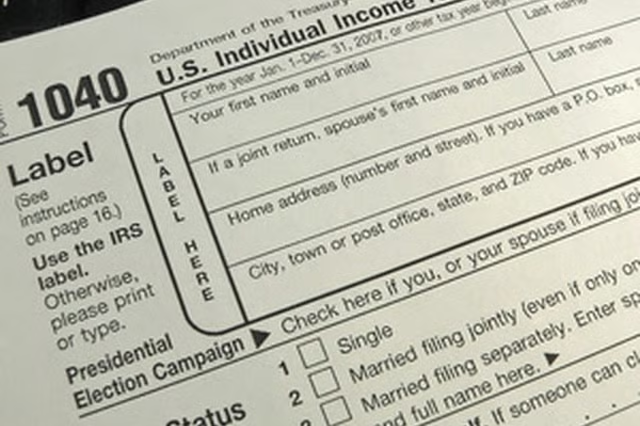
Just because you had income during the year doesn’t automatically mean that you’re required to file a federal income tax return. In most cases, whether or not you’re required to file a tax return depends on your gross income – the amount you made before any tax deductions are considered. But, there are a few exceptions where the IRS could be expecting a return from you even if you had negligible income.
Maximum Earnings Before Paying Tax
The maximum amount of income in a year before you’re required to file a federal tax return depends on your filing status. In addition, just because you’re required to file a tax return doesn’t guarantee you’ll owe taxes. For example, you might make enough to owe taxes, but that income could be offset by various tax deductions, or your tax liability could be offset by tax credits. In addition, remember that sometimes it can be worthwhile to file an income tax return if you’re entitled to a refund of taxes owed or if you qualify for refundable tax credits so that you can claim the tax refund you’re entitled to.
Exceptions for Certain Circumstances
In certain circumstances, you must file a tax return even if have less than the minimum amount to file taxes. For example, if you owe certain taxes, including the alternative minimum tax, the additional tax on early withdrawals from a retirement account, Social Security or Medicare taxes on tips you didn’t report to your employer, you must file. You are also required to file if you had self-employment income in excess of $400 or more than $108.28 of income from a church, if you received any distributions from an Archer MSA, Medicare Advantage MSA, or health savings account, or if you received advanced payments of the health coverage tax credit.
2018 Filing Thresholds
In 2018, you’re required to file a tax return if your income for the year, before any deductions or credits, exceeds the amount of your standard deduction. For singles, that threshold is $12,000. For heads of household, it goes up to $18,000. For married couples filing jointly, the threshold is $24,000.
2017 Filing Thresholds
The tax brackets for 2017 are structured differently because even though the standard deduction was lower, each person was also entitled to a personal exemption unless he or she could be claimed as someone else’s dependent. The standard deductions were $6,350 for singles, $9,350 for heads of household, and $12,700 for married couples filing jointly. The personal exemption further reduced the minimum income before having to file a federal income tax return to $4,050.
