
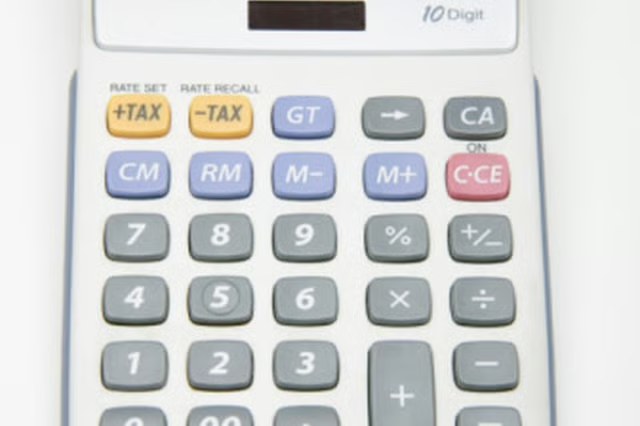


Sales taxes are extra costs tacked on to the purchase price of goods and services. In the United States, most sales taxes are levied by state and local governments. Knowing the amount of sales tax paid can help you better budget. If you have the total purchase price and the price without tax, you can use a sales tax equation to figure out the sales tax and the sales tax rate.
Find the dollar amount of the sales tax by subtracting the pretax price from the post-tax price. For example, if you bought $61 of taxable goods and your total equals $63.44, you would subtract $61 from $63.44 to find that your sales tax cost equals $2.44.
Divide the sales tax cost by the pretax price. In this example, you would divide $2.44 by $61 to get 0.04.
Multiply the Step 2 answer by 100 to convert the sales tax rate from a decimal to a percentage. Finishing the computation, you would multiply 0.04 by 100 to find the sales tax rate equals 4 percent.
